
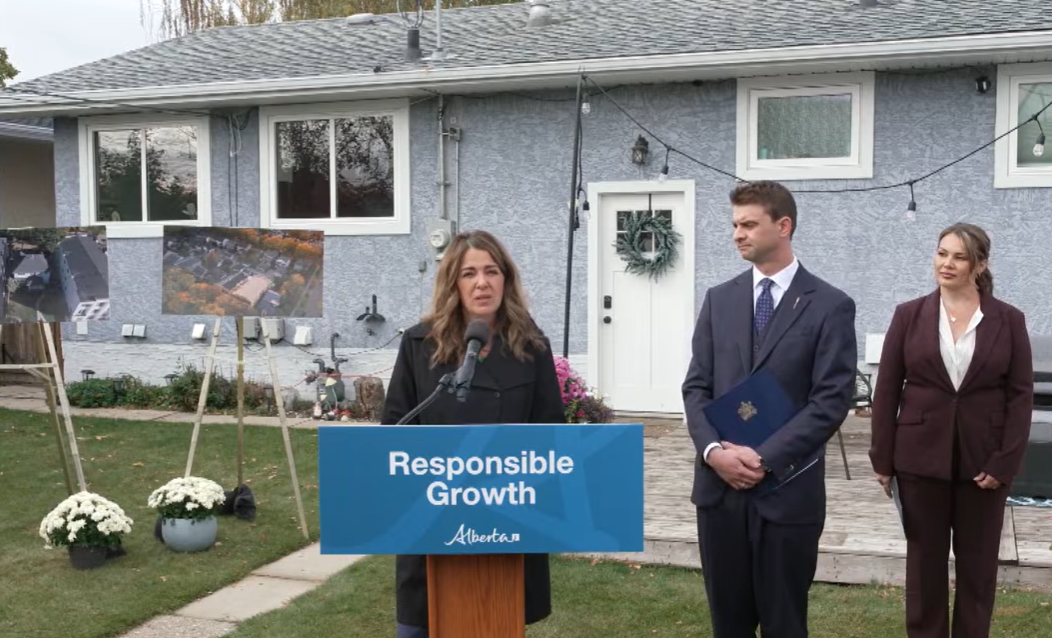
Edmonton's approach to residential infill has become one of the city's most consequential housing debates. At its centre is a question that reaches beyond zoning regulations: How do we create more housing while protecting the livability, character and long-term stability of the neighbourhoods that already exist? On October 8, 2026, Alberta Premier Danielle Smith announced that the provincial government would require Edmonton to roll back key elements of its current zoning framework for high-density residential infill. The announcement followed years of debate about how new multi-unit developments are being introduced into established neighbourhoods, and whether the city's planning rules adequately address residents' concerns. The announcement has brought renewed attention to a complex issue affecting homeowners, prospective buyers, developers and the future of Edmonton's mature communities.
What Did the Province Announce?
Edmonton's zoning bylaw, introduced in January 2024, expanded the types of housing that could be built in residential areas. The changes were intended to accommodate population growth, increase housing choice and make it easier to build additional homes within existing neighbourhoods. However, the changes also reduced some of the restrictions that had previously limited building types, density and height in areas traditionally characterized by detached homes. The removal of mandatory off-street parking minimums became another point of concern for residents in some communities. On October 8, Premier Smith, alongside Municipal Affairs Minister Dan Williams and Jaclyn Soroka, co-founder of Edmonton Neighbourhoods United, announced a provincial intervention. The province directed Edmonton to return to pre-2024 rules for high-density residential infill while the city undertakes a broader review. The direction includes restoring housing-type, density and height limits, as well as reinstating parking requirements that existed before 2020. Edmonton was given three months to amend its bylaw and 18 months to review its land-use rules, consult residents and work with industry on a revised approach. The provincial government says the objective is not to stop infill, but to encourage development that is appropriately scaled and supported by infrastructure. The City of Edmonton, meanwhile, has raised concerns about the effect of the intervention on housing affordability, municipal autonomy and opportunities for homeownership. These differing positions highlight the central challenge: increasing housing supply while determining how, where and under what conditions that growth should occur.Why Established Neighbourhoods Are at the Centre of the Debate
Established neighbourhoods are part of what makes Edmonton distinctive. Many contain mature trees, older homes, walkable streets, established community connections and convenient access to the River Valley, schools, parks and local businesses. These communities can also offer opportunities for thoughtful redevelopment. A larger range of housing types can provide options for people at different stages of life, including downsizers, first-time buyers, smaller households and families seeking more affordable alternatives. The concern arises when the scale of new development changes substantially from the surrounding built environment. Imagine a small, single-storey home built in the 1950s beside a much taller, multi-unit building. That contrast does not automatically make the new building inappropriate. But it raises legitimate questions about building height, privacy, sunlight, setbacks, parking, landscaping, construction quality and how the development fits into the existing streetscape. Residents may also question whether roads, utilities, drainage, schools, public spaces and other services can adequately support additional density. These are not simply questions of whether someone likes a particular building. They are planning questions about compatibility, infrastructure capacity and how the effects of redevelopment are distributed between new residents and people who already call a neighbourhood home. Good planning should consider these factors before development is approved, rather than leaving residents to address the consequences after construction begins.Housing Supply and Neighbourhood Stability Are Both Important
Edmonton needs housing. Population growth, affordability challenges and changing household needs make it important to provide a range of housing options.Infill can help achieve that goal. Adding homes within established areas can make use of existing infrastructure and bring more people closer to transit, services, employment and amenities. Multi-unit housing can also create opportunities for people who might otherwise be unable to purchase a home. At the same time, increasing the number of homes should not be the only measure of successful planning. A development may add housing supply while also creating concerns about parking, privacy, building scale or infrastructure. Conversely, restrictions that are too rigid can limit housing choice, increase costs or make it harder for communities to adapt as their populations change. The challenge is to establish clear, predictable rules that support both responsible development and a reasonable level of confidence for existing homeowners. That means considering the location of a proposed building, the size of the lot, its relationship to neighbouring homes, the capacity of local infrastructure and the cumulative effects of multiple developments on the same streets.It also means recognizing that a neighbourhood is more than a collection of individual properties. It is a connected environment in which changes to one site can affect the experience of people living nearby.What Does This Mean for Homeowners and Property Values?
For homeowners, redevelopment can bring both opportunities and uncertainty. Some properties may benefit from new amenities, improved streetscapes or increased demand as neighbourhoods evolve. Other homeowners may have concerns about the immediate effects of a nearby development, including reduced privacy, construction disruption, changes in outlook or a loss of features that originally attracted them to the area. Property value is particularly important, but it requires careful consideration. A nearby multi-unit building does not automatically reduce the value of every surrounding property. The effect depends on factors such as location, design, construction quality, buyer preferences, market conditions and the specific relationship between the properties. As a REALTOR®, I believe it is important to distinguish between a homeowner's understandable concern and a measurable market outcome. When assessing the effect of redevelopment, we need to look at the individual property and relevant market evidence rather than assume that every project will have the same result. My perspective is also informed by direct experience. I live in an established neighbourhood near Edmonton's River Valley, have participated in the development appeal process as a resident, and have represented sellers whose properties were affected by nearby multi-unit development. Those experiences have shown me how deeply these decisions can affect people who have invested not only money, but years of their lives, into their homes and communities. They have also reinforced the importance of evaluating development impacts early, communicating clearly and ensuring residents have meaningful opportunities to participate in decisions that affect them.The Importance of Meaningful Public Consultation
One of the most important parts of this debate is the relationship between residents and the institutions responsible for planning their communities.Edmonton's zoning changes were intended to respond to housing needs, but some residents have argued that their concerns about the pace and scale of infill were not adequately addressed. Community advocacy groups, including Edmonton Neighbourhoods United, have called for a more responsive planning process. The provincial intervention has been welcomed by some residents who believe existing rules did not sufficiently protect neighbourhood compatibility. Others, including Edmonton's mayor, have criticized the province's approach and raised concerns about local decision-making and the consequences for housing affordability. Both the policy decision and the process used to reach it deserve scrutiny. Meaningful consultation is more than inviting residents to a meeting after the main decisions have already been made. It involves providing understandable information, listening to affected communities, explaining how feedback is considered and making the reasoning behind final decisions transparent.Residents should have a voice. Developers should have clear expectations. Municipal planners should have the tools to evaluate proposals consistently. And governments should be accountable for how their decisions affect both current and future residents. The upcoming review provides an opportunity to improve that process.What Should Responsible Infill Look Like?
Responsible infill does not have to mean choosing between detached homes and higher-density housing. It means considering the context in which new housing is built.A thoughtful approach should include:- Appropriate scale and design: Building height, massing, setbacks and exterior design should be evaluated in relation to surrounding properties and the character of the street.
- Infrastructure capacity: Water, drainage, roads, sidewalks and other services should be considered alongside proposed growth.
- Parking and transportation: Planning should account for how residents, visitors and service vehicles will access and use the area.
- Construction quality and enforcement: Clear standards and effective oversight help protect neighbouring properties and ensure approved plans are followed.
- Meaningful community engagement: Residents should have accessible opportunities to provide input before decisions are finalized.
- Housing choice and affordability: Policies should continue to create opportunities for different household types, including people seeking attainable homeownership and rental housing.